You can be doing fine and still be running on empty
Most independent consultants can feel the pressure long before they can name it. Peter Adams, TruthWorks community member, built a diagnostic called the Freelance Wheel of Work to close that gap. In his words: the pressure in independent consulting right now is almost never one big problem you can point at. It is eight different-sized smaller ones, and most people can describe the general weight of it long before they know how to address it.

Diagnosis is key
The wheel is designed to diagnose the underlying issues and get specific. For example, "I am tired" and "I am tired because three of my four clients now expect AI-speed turnaround at last year's rate" technically describe the same feeling. BUT only the second one tells you where the actual problem is.
Three pressures are landing on the same person at once
The pool of available independent talent is bigger than it was. Companies that hired heavily have spent the last stretch cutting back, and freezes on replacing the people who leave have pushed a lot of experienced professionals into independent work, all of them looking at a similar set of projects.
At the same time, AI was all abuzz and being sold to a lot of leadership teams as a fast, cheap answer, and the reality of what the tools actually do has been catching up with what clients expect for months now. A deliverable that used to take three days can be roughed out in an hour with a tool your client also has access to, and it is changing what clients expect to pay for the work itself.
The third pressure is quieter than the other two. Doing the work and winning the work are two different skills, and with more experienced people chasing the same projects, the second skill is being asked for more than it used to be. Whether you have had much cause to use that skill before is worth knowing. Being good at the work is not the part in question.
What all of this does is make the pressure uneven, and uneven pressure tends to take a toll after a while.
The Freelance Wheel of Work puts the pressure somewhere specific
You can draw the wheel by hand, or use the printable version linked below. If you are drawing it by hand, start by drawing a circle, split it into eight even segments, and label them:
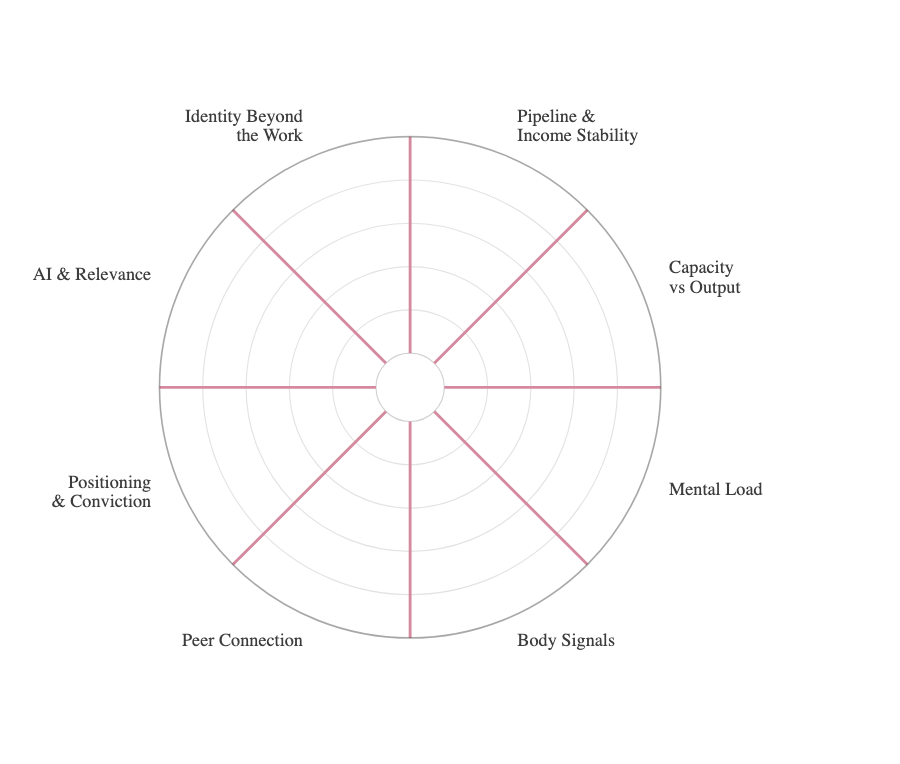
Read the topic below for each area, and mark up the circle as you go.
Pipeline & Income Stability – How predictable and diversified is your income?
Look at where the money actually came from over the last six months, rather than where you would like it to come from. If one client or one type of work could disappear and take more than half of it with them, that is the number this area is asking about.
Capacity vs Output – Are you trading future capacity for present income?
This is about whether you have already said yes to more than you have room for, quietly, without it ever becoming a decision. If proposal writing and thinking time have drifted into evenings and weekends, that drift is the signal, not the size of the workload.
Mental Load – How heavy is the “CEO of everything” tax right now?
Strategist, seller, delivery, admin, credit control: most of it lives in your head rather than in a system or a document you could hand to anyone. The tiredness in this area tends to come less from the work itself than from never being fully off the hook for any of it.
Body Signals – What is your body telling you that you’re ignoring?
This one usually turns up in the same few places: sleep, jaw, shoulders, the appointment you keep meaning to book. You most likely already know your answer here, and how quickly it arrived is itself part of the score.
Peer Connection – Who actually sees your work, not just the output?
Notice how many of your conversations this month were with clients, and how often you were the one holding the room. When a piece of work lands badly, and sometimes it does, this area is whether you have anyone to think it through with who is not being billed for the privilege.
Positioning & Conviction – Are you still convinced by the offer you’re selling?
You can be delivering something well and still feel yourself go flat every time you describe it. Watch for the small tells rather than a big one: softened pitches, extra caveats, letting the client set the scope because arguing for your own version is not worth this week’s energy.
AI & Relevance – Is AI changing what clients will pay you for, and are you ahead of it or behind it?
If a client could get a rough version of your last deliverable from a tool in an hour, the honest question is what you are adding on top of that now. If the value has moved from the deliverable to your judgement, this area is whether your pricing has caught up with that yet.
Identity Beyond the Work – Who are you when the work stops, and does it scare you?
Notice whether introducing yourself and describing your work have become the same sentence, and whether a quiet week feels like something has gone wrong with you rather than with the pipeline. Answer this one the way you would answer it to someone who knows you, not the way you would answer it on LinkedIn.
Then score each one on how resourced you feel there right now, today, rather than on how it looks on paper. A dot on each spoke, close to the centre if you are running thin, further out if you genuinely have something in reserve, and then join the dots up. What you get is a spider graph shape, and seeing it on paper in front of you shows you pretty quickly that you can be doing fine in an area and still be running on empty in it. It is that gap, rather than the lowest number on the page, that tells you where to put the next 48 hours.
Give yourself 10 minutes.
You have everything you need to score yourself from here. What the worksheet adds is a printable wheel ready to mark with a pen, this full article, and an example 48-hour action for each of the eight areas. Download and print it at peteradams.coach/freelance-wheel-of-work.
Two of the eight catch people out more than the rest.
{{quote-item-1}}
AI and relevance is the one area you can test in an hour
Rather than answer that question from a feeling, run it. Take one deliverable you produced in the last month, put the raw brief into an AI tool, and look at what comes back. Initially, this might be uncomfortable, but the useful part is the gap between what the tool produced and what you would have produced, because that gap, specifically, is what your offer currently is. A wide gap suggests you are fine, and possibly charging too little for your own judgement. A narrow one is worth knowing now rather than in six months, because it tells you exactly where to start differentiating yourself from AI.
Positioning and conviction is the one that goes quiet first
This one is harder to catch, because it does not announce itself. You can keep delivering something well and still feel yourself go flat every time you describe it. The small tells arrive well ahead of the big one: you soften the pitch, you add a caveat you did not used to add, you let the client set the scope because arguing for your own version is not worth this week’s energy, you are quietly relieved when a call gets cancelled. Usually what that adds up to is drift: the work you are most interested in now has moved away from the work you are actually selling, and you have not quite named that to yourself yet. It is simply the gap between what you are offering and where your attention has already moved.
Score the shape, then pick the area that surprised you
What the wheel gives you is a location. That is a harder thing to produce from memory than a general verdict on how the year is going, and a far more useful one.
So print the worksheet, or finish marking the one above if you have been drawing along, and pick one area to work on: the one that surprised you, rather than automatically the lowest score. Then decide what you want to do about it: one action inside the next 48 hours, small enough that you will actually do it and specific enough that you will know when it is done. If pipeline was the one, that might be as small as opening your invoicing and working out what percentage of the last six months came from your single biggest client. My guess is you already know which area and what action it is going to be.
Peter Adams is a life coach and strategic partner based in Ibiza, working with senior professionals and independent consultants worldwide. Half deep pattern work, half strategic accountability, with facilitation and coaching contracts across adidas, Philips, ACICS and dsm-firmenich.
Key Take-aways
- Eight areas, one shape: pipeline, capacity, mental load, body signals, peers, positioning, AI, identity.
- AI & relevance and positioning & conviction catch more people out than the other six.
- The move is one specific 48-hour action, not a general intention to look at all eight.




Need an Expert for your challenge?
We've sourced the best independent global talent so you don't have to. Every People and Culture specialism covered in one place by our trusted Experts. Search, book, brief and pay through one easy-to-use platform.
Explore Experts